Vehicle Loading And Unloading – What You Need To Know
Before you start loading you need to ensure the vehicle / trailer is on firm, level ground, the brakes are applied and there is sufficient room for you to access both sides of the vehicle with your forklift truck. If the driver is present you should obtain the vehicle keys from him until you have completed loading. If loading a vehicle from a stepped loading dock it is especially important to remove the keys from the ignition so that the driver cannot drive away before you have finished loading. Some loading docks have various different methods to lock the trailer onto the dock to prevent the vehicle from pulling away and you should be aware of the safety procedures in place at your particular site.
The correct way to go about loading a flat bed lorry or trailer is to start at the head board. Please note if this is a trailer, detached from the tractor unit, you need to think about how much weight you are putting onto the front as there is quite a long overhang from the legs of the trailer to the headboard and putting too much weight on the front of an unsupported trailer can cause it to tip up, especially if you are double stacking loads. Ideally, the vehicle trailer will have a tractor unit attached to it or you could think about putting a stack of unladen pallets under the front of the trailer to give the trailer some more stability. Using standard pallets pick up the pallets on the narrow face and put your first pallet with the wide face of the pallet up against the head board of the vehicle on one side. Your second pallet will then go onto the other side exactly opposite the first pallet. Continue loading alternating from one side to another and once you have the same amount of pallets behind the supporting legs of the trailer as there are in front of, you can then remove your stack of empty pallets from underneath the front of the trailer. Continue loading alternating sides pallet by pallet until you have completed your load. You can normally get between 20 – 24 standard pallets on a 40 ft trailer.
Offloading a trailer will be the exact reverse of this so take off pallets alternating from side to side, starting at the back of the trailer but again be aware that you may need to support the front end of the trailer if there is no tractor unit attached.
Please note if you are loading a container lorry or trailer from within a stepped loading dock, you need to make sure that the front of the trailer is supported if there is no tractor unit attached before driving onto the bed of the trailer with your forklift truck plus load as the combined weight can very easily tip up an supported trailer. It is really important to remove vehicle keys to prevent the driver pulling away before you have completed loading.
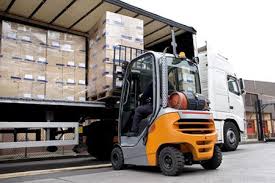
There must be safeguards against drivers accidentally driving away too early.
This does happen, and is extremely dangerous. Measures could include:
- Traffic lights.
- The use of vehicle or trailer restraints.
- The person in charge of loading or unloading could keep hold of the vehicle keys or paperwork until it is safe for the vehicle to be moved.
- These safeguards would be especially effective where there could be communication problems, for example where foreign drivers are involved.
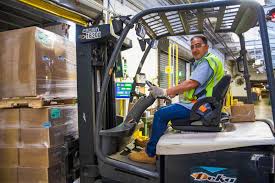
How to Use a Forklift to Unload a Shipping Container
A shipping container may be parked on the ground and needs to have contents put in or taken out, but there is a lip between the ground and the floor of the container. To safely access the container with a forklift, you need a dock board. Dock boards are also used in between a loading dock and the trailer or container. They will have enough capacity to support the forklift and the cargo being moved.

Forklifts and the Hazards of Loading and Unloading
On almost every substantial construction project, forklifts are used to move materials and these workhorses require careful safety precautions – The Bureau of Labor Statistics reports that in the United States, nearly 100 workers are killed and another 20,000 are seriously injured in forklift-related incidents each year. Loading and unloading materials is of particular concern although forklift overturns are the leading cause of fatalities involving forklifts; they represent about 25% of all forklift-related deaths.
Experts cite the following basic safety measures for loading/unloading:
- Even on level ground, there is a risk of machine roll-over during loading or unloading. Make sure you are centered on the ramps and stay straight. Allow enough room to maneuver the trailer and machine, which is sometimes difficult on tightly compressed jobsites.
- Use a spotter for guidance. Make sure the machine clears the ramps before turning. Keep people away from the sides of the machine during loading/unloading.
- Check the trailer deck, clearances and stability. Review your lock-out/tag-out plan to be sure the machine is at “Zero Energy State” when stowed.
- Use proper tie-down procedures. If using compression chain binders, use caution when opening the handle. The load may shift just enough to add tension to the chain and the handle may spring open. Use safety tie wires or switch to ratchet binders.
- Secure Your Load
Safe Fork Use
The first and most important rule to follow with forklifts – don’t overload your equipment. You have to know the weight of what you are lifting or risk tip over. If you spill the load it will take you more time to clean it up than to split the load into two picks.
Many injuries to both the operator and co-workers occur because they were not familiar with the specific model and type of forklift. Take the time to walk around and look over the manual. Take the Opportunity to ask others who use that equipment, and practice a bit on the side in the open before jumping right in with a load.
Safe operating procedures depend on the specific type of lift. Not all forklifts work the same. Always perform a written Daily Equipment Inspection before using the machine.
Always remain a safe distance and keep away from the swing area of the forklift. If you are the operator count & know how many grounds men are working with you. Once you are ready to pick the load the OPERATOR is in charge of the work until the load is back on the ground or bed of a truck. Respect this rule.
Never stand on or under the forks of the lift. Never ride on the side of a lift. Never use a forklift to raise or lower people. Both the operator and the rider are subject to company discipline action for these infractions. Using forks on equipment or a forklift is not a game.
Always pay attention to horns and back-up alarms from all heavy equipment, including forklifts. If operating any heavy equipment, always use seatbelts 100% of the time. More often you will sustain more or greater injury from a tip over if not wearing a seatbelt.
LOAD SECUREMENT
Secure the load to the frame and not the forks. Make sure the forks are all the way under the pallet and load before lifting.
Use a spotter to ensure the load is stable and guide you into the rack or atop the truck. Adjust the forks to be a proper width for the item to be lifted; too narrow it can fall off & too wide it can fall through.
Always lift just a few inches to check everything is ok before proceeding. Secure the load with s strap if you have to travel with it or lift it very high up. Whenever a load is on its “Slow–As-You-Go”.